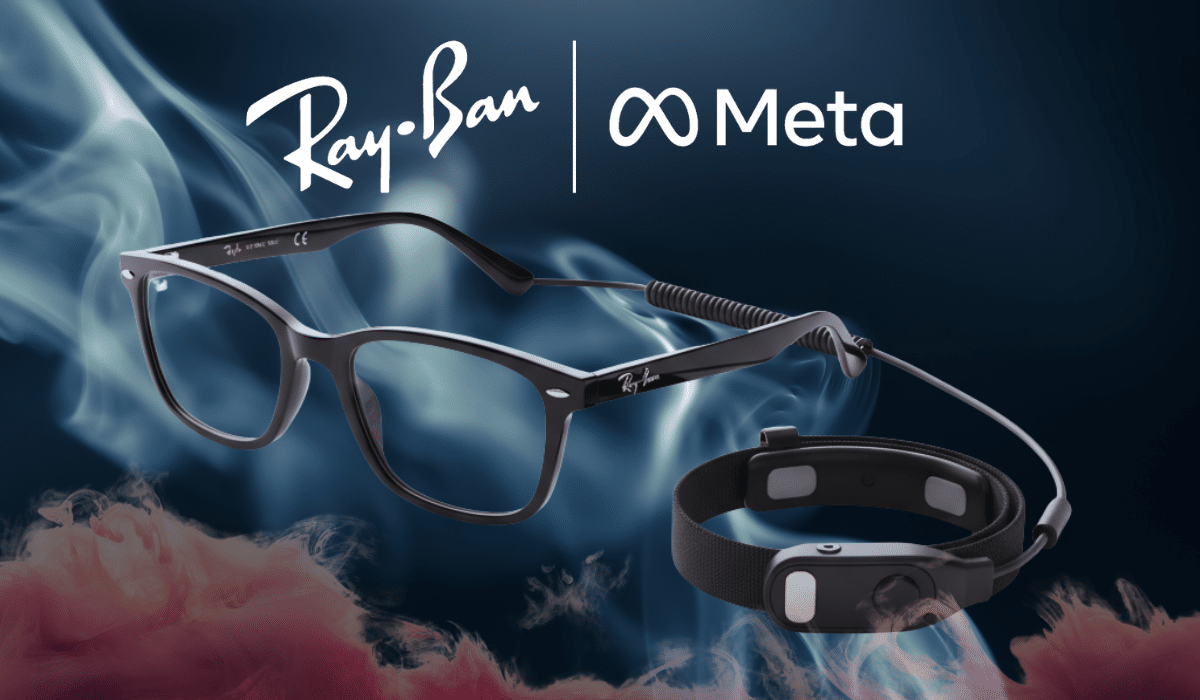
Meta Ray-Ban Display glasses represent the first consumer-ready smart glasses with integrated display technology, officially announced at Meta Connect 2025. These groundbreaking AR glasses combine a 600×600 pixel display with advanced EMG wristband control, launching September 30, 2025. The $799 price point positions them as a direct competitor to Apple’s Vision Pro while offering unprecedented portability and everyday wearability.
Key Highlights
- $799 price includes both glasses and Meta Neural Band with EMG control
- 600×600 display resolution with 90Hz refresh rate and 20-degree field of view
- 6-hour battery life with 30 total hours using charging case
- September 30, 2025 launch exclusively in US retail stores
- 12MP camera with 3x zoom and built-in viewfinder display
Table of Contents
Smart Glasses With Display: Game-Changing Technology
The Meta Ray-Ban Display glasses feature a revolutionary micro-projector system that displays information directly onto the right lens. Unlike traditional AR headsets, these glasses maintain a lightweight 69-gram design while delivering 5,000 nits brightness for outdoor visibility. The monocular display approach ensures users maintain full peripheral vision while accessing contextual information hands-free.
The integrated display supports multiple app ecosystems including WhatsApp, Instagram, Spotify, and Google Calendar. Users can read messages, view photos, navigate maps, and control media without touching their smartphones. This represents a significant evolution from the previous Ray-Ban Meta Smart Glasses generation, which lacked display capabilities entirely.
Meta Connect 2025 Announcements: AR Revolution Begins
Meta’s latest Meta Connect 2025 announcements positioned these display glasses as the cornerstone of their three-tier AR strategy. CEO Mark Zuckerberg demonstrated live messaging, video calling, and real-time translation features during the keynote presentation. The company revealed that over 2 million users already own previous-generation Ray-Ban Meta glasses, creating a ready market for the display upgrade.
The announcement coincides with major technology partnerships, similar to recent collaborations like the Nvidia-Intel partnership worth $5 billion, highlighting how tech giants are investing heavily in next-generation computing platforms. Meta’s $799 pricing strategy directly challenges Apple’s $3,499 Vision Pro while targeting mainstream consumers rather than enterprise users.
EMG Wristband Control: Hands-Free Innovation
The revolutionary EMG wristband control system uses electromyography to detect muscle signals at the wrist, translating finger movements into digital commands. Users can pinch their index finger to select items, middle finger to navigate back, or create sideways fists for swiping motions. This technology eliminates the need for visible hand gestures, enabling discreet control even when hands are below tables or behind backs.
The Neural Band offers 18 hours of independent battery life and connects seamlessly with the glasses via low-power Bluetooth. Advanced machine learning algorithms interpret micro-movements with 95% accuracy, according to Meta’s internal testing. This represents a significant advancement over camera-based gesture controls used in competing products like Apple Vision Pro or Magic Leap headsets.
AR Glasses Price India: Market Impact Analysis
While AR glasses price India remains unconfirmed, the $799 US pricing translates to approximately ₹67,000 including import duties and taxes. Meta plans international expansion to Canada, France, Italy, and the UK in early 2026, with India likely following in late 2026. Current Ray-Ban Meta glasses retail for ₹29,900-₹35,700 in India, suggesting the Display version could target the ₹60,000-₹70,000 premium segment.
The Indian smart wearables market grew 170% in 2024, with premium devices above ₹50,000 showing strongest growth among urban consumers. Meta’s partnership with Ray-Ban provides established retail distribution through LensCrafters and Vision Express outlets across major Indian cities, potentially accelerating adoption compared to purely online AR competitors.
Ray-Ban Smart Glasses Features: Comprehensive Specifications
Ray-Ban smart glasses features in the Display model include significant upgrades over previous generations. The 12MP camera supports 3x optical zoom with real-time viewfinder display, eliminating guesswork when framing shots. Six-microphone arrays enable clear voice commands and phone calls, while open-ear speakers provide private audio without blocking ambient sounds.
Prescription lens support ranges from -4.00 to +4.00 diopters, accommodating most vision correction needs. Transition lenses automatically adjust to lighting conditions, switching between clear indoor and dark outdoor tinting. The compact folding charging case provides wireless charging and protective storage, addressing common durability concerns with previous smart glasses generations.
Smart Glasses vs Apple Vision Pro: Market Positioning
The smart glasses vs Apple Vision Pro comparison reveals distinct market strategies. While Apple‘s $3,499 Vision Pro targets immersive spatial computing, Meta’s $799 Display glasses focus on augmented information overlay. The Vision Pro offers superior display quality and processing power but weighs 650 grams compared to Meta’s 69-gram design.
Battery life favors Meta with 6 hours mixed-use versus Apple’s 2-hour typical usage. However, Apple Vision Pro supports full app ecosystems and professional workflows, while Meta glasses limit functionality to mobile app extensions. For everyday consumers prioritizing portability and affordability, Meta’s approach offers clear advantages over Apple’s premium positioning.
Wearable Technology 2025: Industry Impact
Wearable technology 2025 trends indicate growing consumer acceptance of AR-enabled devices, with global smart glasses shipments projected to reach 12 million units. Meta’s display glasses could capture significant market share by addressing previous concerns about battery life, display quality, and social acceptability. The Ray-Ban partnership provides fashion credibility that purely tech-focused brands like Google Glass lacked.
Industry analysts predict Meta’s approach will influence competitors including Apple, Google, and Snapchat to develop similar mainstream AR glasses. The $799 price point establishes a new market category between basic smartwatches and premium AR headsets, potentially accelerating mass adoption of augmented reality technology.
Conclusion
Meta Ray-Ban Display glasses mark a pivotal moment in consumer AR technology, combining practical functionality with mainstream appeal at $799. The September 30 launch exclusively through US retail stores positions Meta ahead of competitors in the race for everyday augmented reality adoption. With international expansion planned for 2026, these display-enabled smart glasses could finally deliver on the promise that Google Glass pioneered over a decade ago.
Frequently Asked Questions
Q1. When will Meta Ray-Ban Display glasses launch in India?
Meta plans international expansion in early 2026 starting with Canada, France, Italy, and the UK. India availability is expected in late 2026, with pricing likely around ₹67,000 including taxes.
Q2. How long does the battery last on Meta Ray-Ban Display glasses?
The glasses provide 6 hours of mixed-use battery life per charge. The included charging case extends total usage to 30 hours before requiring wall charging.
Q3. Can I use prescription lenses with Meta Ray-Ban Display glasses?
Yes, the glasses support prescription ranges from -4.00 to +4.00 total power. Ray-Ban retail locations offer professional fitting services for prescription lens installation.
Q4. What’s the difference between these and regular Ray-Ban Meta glasses?
The Display model adds a 600×600 pixel screen in the right lens, EMG wristband control, and enhanced camera features. Regular Meta glasses lack the display and wristband, focusing on voice control and basic camera functions.